Star Club: A Creative Dingbats Font for Editorial Design
I was sitting at my desk last Tuesday, staring at a blank Canva canvas, trying to figure out how to make a simple newsletter header feel less like a corporate memo and more like a personal invitation. The client wanted something playful but polished—a "cool, creative" vibe that would stop the scroll without screaming for attention. I had tried several script fonts, but they felt too chaotic. I had tried standard sans serifs, but they felt too sterile. That’s when I remembered Star Club.
It wasn’t the headline font I initially reached for, but as a dingbats typeface, it offered exactly the visual rhythm I needed to break up the monotony of text-heavy layouts. If you are an editorial designer, publisher, or content creator looking to elevate your publication identity, understanding where display and decorative fonts fit into your workflow is crucial. Star Club is not just a collection of symbols; it is a tool for building mood, structure, and visual interest in modern typography.
Understanding the Visual Character of Star Club
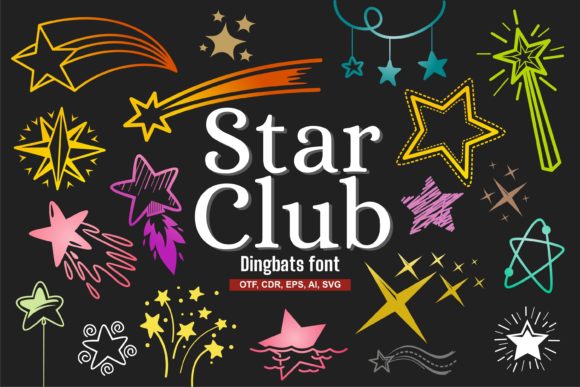
Before diving into specific use cases, it helps to understand what makes this font tick. Star Club is classified as a dingbats font, which means its primary utility lies in its glyphs rather than traditional alphabetic characters. However, its design philosophy is deeply rooted in modern typography principles. The shapes are clean, geometric, and surprisingly versatile. They possess a relaxed personality that feels contemporary yet timeless.
In the world of design assets, there is a fine line between a font that adds character and one that distracts from the message. Star Club sits comfortably on the useful side of that line. It has a distinct visual weight that commands attention without overwhelming the eye. Whether you are designing a digital magazine layout or a printable planner, the consistency of these glyphs allows them to function as both decorative accents and structural elements. This balance is rare in the creative font market, where many dingbats options lean too heavily into novelty or clutter.
The font’s ability to convey mood is its strongest asset. It feels optimistic, organized, and slightly whimsical. This makes it an incredible asset for brands that want to appear approachable and trustworthy. When integrated correctly, it doesn’t just decorate; it communicates a sense of care and attention to detail that readers subconsciously pick up on.
Real-World Applications in Content Structure
Let’s look at how Star Club performs in actual publishing scenarios. I recently tested this typeface across three different project types: a lifestyle blog redesign, a recipe ebook, and a coaching workbook. Here is how it held up in each context.
The Lifestyle Blog Redesign
For a recent blog overhaul, the goal was to create a stronger brand identity through consistent visual cues. Instead of using complex illustrations, we used Star Club as a recurring motif. We placed small star icons next to section headings, used bullet points derived from the font for lists, and even created a custom divider using repeated glyphs. This approach maintained a high level of readability while adding a layer of bespoke branding. It proved that a premium font can serve as a comprehensive design system when used with intention.
The Recipe Ebook
Recipe ebooks require clear hierarchy. You need titles that pop, instructions that are easy to follow, and ingredients that are scannable. In this project, we used Star Club for the chapter openers and pull quotes. For example, a tip box might be framed by a border made entirely of Star Club characters. This draws the eye immediately to the advice without disrupting the flow of the recipe steps. It acted as a visual anchor, guiding the reader through the content structure naturally.
The Coaching Workbook
Workbooks often suffer from being visually dense. To combat this, we used Star Club for interactive elements—checkboxes, progress trackers, and motivational callouts. The geometric nature of the glyphs made them perfect for UI-like elements within a PDF. Because the shapes are simple, they render clearly even at smaller sizes, which is critical for printable guides and worksheets that users might print at home.
Readability and Screen Considerations
One of the most common questions designers ask is whether a dingbats font can support readability. The honest answer is: no, not for body copy. Star Club is a display font designed for impact, not endurance. Using it for long-form content will fatigue the reader and obscure your message. Its true power lies in supporting the text, not replacing it.
When designing for screens, particularly mobile layouts, legibility is paramount. Star Club shines in larger sizes where its details can breathe. It works beautifully for:
- Blog Headers and Titles: Creating a memorable first impression.
- Pull Quotes: Highlighting key takeaways in articles.
- Section Headings: Breaking up walls of text in digital magazines.
- Social Media Graphics: Adding quick visual flair to Instagram posts or Pinterest pins.
However, caution is advised for small captions or dense paragraphs. If you are creating a formal report or a legal document, Star Club may be too expressive and informal. In those cases, sticking to a reliable serif font or a neutral sans serif font is safer. But for editorial features, newsletters, and creative projects, its expressive nature is a feature, not a bug.
Strategic Font Pairing for Editorial Design
To get the most out of Star Club, you must pair it wisely. The golden rule of font pairing is contrast. Since Star Club is a distinctive, graphic-heavy dingbats font, it needs a calm, readable partner to ground the design.
For body text, a classic serif font provides an elegant contrast that elevates the overall aesthetic. Think of a high-contrast serif for headlines if you aren't using Star Club there, paired with Star Club for accents. Alternatively, a clean sans serif font works well if you are aiming for a more modern, minimalist look. The simplicity of the sans serif allows the complexity of the Star Club glyphs to stand out without competing for attention.
Consider a wedding guide layout: use a delicate script font for the main title, a clean sans serif for the logistical details, and reserve Star Club for the decorative borders and iconography. This creates a layered typographic hierarchy that feels professional and curated. Similarly, in web design or logo design, using Star Club as a secondary element can add a unique signature to a brand identity without compromising clarity.
Practical Tips for Implementation
Before downloading and integrating Star Club into your projects, keep a few practical considerations in mind. First, always check the included styles. Does it offer multiple weights? Are there alternates or ligatures that allow for more dynamic compositions? These features can significantly expand the font’s utility in packaging design or brand identity projects.
Second, verify the file formats. For web use, ensure you have web-ready formats (WOFF/WOFF2) if the font supports it, though dingbats are often embedded as images or SVGs in graphic design software. For print materials, high-resolution PDFs or vector files are essential to maintain crisp edges.
Finally, pay close attention to commercial licensing. If you are creating templates, paid newsletters, or digital downloads for sale, you need a license that permits resale or redistribution. Many commercial font licenses vary based on the number of end-users or the volume of printed copies. Understanding these terms protects your business and respects the creator’s work.
Ultimately, Star Club is more than just a set of cool shapes. It is a strategic design choice that can enhance readability, reinforce publication identity, and bring a touch of creativity to structured content. By using it thoughtfully—as an accent, a structural helper, or a mood setter—you can transform ordinary layouts into engaging editorial experiences. Whether you are designing a course PDF, a newsletter header, or a full magazine spread, giving Star Club a place in your toolkit is a smart move for any serious content creator.